
Categories
Buyer Resources, Buying a Home in NC, First-Time Home Buyers, Pitt County Real EstatePublished April 21, 2026
First-Time Homebuyers in NC: Programs, Grants & Next Steps

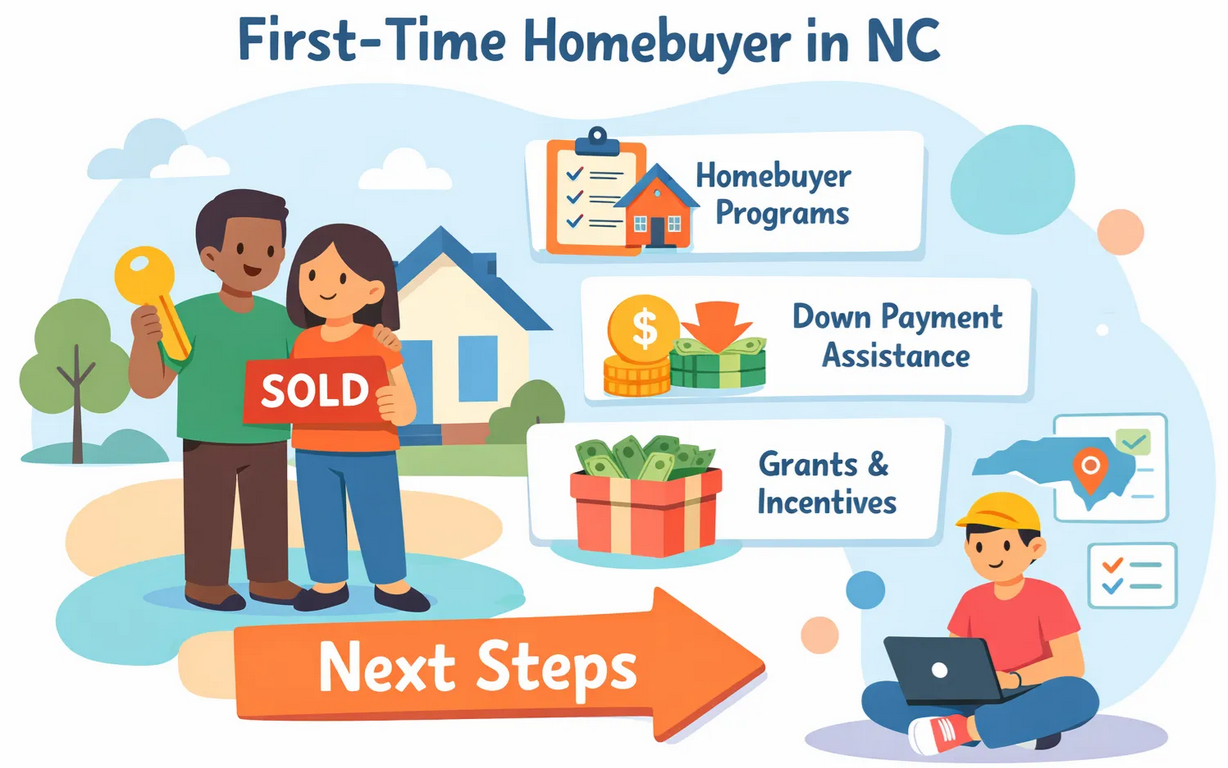
If you're a first-time homebuyer in North Carolina, you have access to more assistance than most people realize. The NC Housing Finance Agency runs several programs that can put thousands of dollars toward your down payment and closing costs, and cities like Durham, Raleigh, and Charlotte stack their own local assistance on top of that. The programs are active and well-funded. The barrier is usually just not knowing where to start.
That said, this process has real steps, real paperwork, and real deadlines. Programs run out of funding. Applications get delayed when documents are missing. Buyers who don't complete their education requirement before closing get disqualified. A clear plan, worked in the right order, is what separates buyers who close on time from buyers who miss out. This article gives you that plan, from understanding your eligibility through walking out with keys in hand.
One thing worth noting upfront: these programs apply statewide, but how you navigate them depends heavily on where you're buying. A buyer in Charlotte works with different local programs, lenders, and market conditions than a buyer settling in Eastern NC. That local context matters more than most guides admit.
First Time Home Buyer North Carolina: Eligibility & Assistance
NC programs define a "first-time homebuyer" as someone who hasn't owned a home as their primary residence in the past three years. That rule reopens eligibility for divorced homeowners, people who sold during a move, and anyone who owned years ago but has been renting since. If you haven't had your name on a deed in the last 36 months, you qualify as a first-time buyer under state program guidelines. Many buyers who assume they don't qualify find out quickly that they do.
How NC programs define "first-time buyer"
The three-year lookback rule is the standard definition across NCHFA programs, but military veterans get additional flexibility. Veterans don't need to meet the first-time buyer requirement at all to access the NC 1st Home Advantage Down Payment program. This provision is widely overlooked among eligible veterans, and it applies regardless of whether a veteran has owned a home before.
For non-veterans, the key question is simple: have you held ownership of a primary residence any time in the past three years? If the answer is no, you meet the first-time buyer definition and should move forward with a full eligibility check.
Credit score and debt-to-income thresholds to know
The credit score minimum for most NCHFA programs is 640. New manufactured homes require a 660 minimum. Lenders will pull scores for all borrowers on the application and use the middle score (or lower score if only two bureaus report), so every person on the loan matters. If you have a co-borrower with a lower score, that number drives the underwriting decision.
The debt-to-income limit across NCHFA programs is 45%. In practice, that means your total monthly debt payments, including the new mortgage, car loans, student loans, and credit cards, can't exceed 45% of your gross monthly income. If you're earning $5,000 per month, your total debt load after buying the home can't exceed $2,250. Running this calculation yourself before you apply gives you a realistic picture of your purchase power.
Why getting pre-approved is your actual first step
Pre-approval isn't just a budget exercise. For NCHFA programs, it's a functional requirement. You can't submit an application for most state assistance programs without a pre-approval letter from an NCHFA-approved lender, because the lender handles the agency submission on your behalf. The pre-approval also signals to sellers that you're a serious buyer, which matters in competitive markets. During pre-approval, lenders verify income, employment history, credit, and assets, so gather your documents before you call.
NC Housing Finance Agency Programs for First Time Home Buyers
The NC Housing Finance Agency is the primary engine behind homebuyer assistance in North Carolina. Most of the meaningful down payment help in the state flows through NCHFA, either directly through their programs or through participating lenders they've approved. If you're buying anywhere in NC, these are the programs you evaluate first. You can review the NCHFA's community home buying programs for details on the options available through the agency.
NC Home Advantage Mortgage: the foundation loan
This is a fixed-rate first mortgage offered through NCHFA-approved lenders and compatible with FHA, VA, USDA, and conventional loan types. The income limit is $134,000 for most configurations, and the statewide purchase price cap is $480,000 (verify current figures at nchfa.com, as limits update periodically). Unlike some state programs, the NC Home Advantage Mortgage is open to both first-time buyers and move-up buyers in certain scenarios, making it one of the more flexible options in the NCHFA lineup.
It's also the required foundation loan if you want to layer on the $15,000 down payment assistance described below.
NC 1st Home Advantage Down Payment: the $15,000 assistance option
This is the program most first-time buyers in NC should be looking at. It provides $15,000 as a 0% interest deferred second mortgage with no monthly payments required. The balance is forgiven 20% per year starting at the end of year 11, reaching full forgiveness at the end of year 15. If you sell or refinance before the forgiveness period completes, you repay the remaining unforgiven balance at that time. For full program details, see the NC 1st Home Advantage Down Payment page.
Who qualifies: first-time buyers (using the three-year rule) and military veterans. You must pair this with an NC Home Advantage Mortgage, and standard eligibility requirements apply. These include the 640 credit score minimum and a DTI at or below 45%. Buyers who stay in the home through the full 15-year period have the entire balance forgiven.
Income and purchase price limits by county
Income limits for the NC 1st Home Advantage program vary by county and household size, ranging from roughly $87,000 to $134,000 depending on your location. The statewide purchase price cap of $480,000 applies across both flagship programs. Because these limits shift by county and update periodically, the most reliable way to check your specific numbers is to consult the program materials and county-level guides; see the NCHFA 15,000 Down Payment Assistance Program Guide for current guidance and program specifics. Look up your county and household size before assuming you're over or under the threshold.
Local Down Payment Grants in Raleigh, Charlotte, Durham, and Beyond
State programs give you a foundation, but many NC cities layer their own assistance on top, sometimes substantially. These local programs have their own income limits, property requirements, and funding cycles, and they run out. Knowing what's available in your target city and applying early is the difference between getting help and missing the window.
What Raleigh, Charlotte, Durham, and Greensboro offer
Here's a factual breakdown of what each major city currently offers:
- Raleigh: Up to $45,000 for any single-family home, condo, or townhome within city limits; up to $60,000 in targeted geographic areas through the Enhanced program, which carries a 10-year deed restriction on sales proceeds. Income limit is 80% AMI, and applicants must not have owned a home in three years. See theRaleigh homebuyer assistance pagefor application details and current income limits.
- Charlotte (House Charlotte): Up to $30,000 for buyers at or below 80% AMI; up to $10,000 for buyers between 80% and 110% AMI. Requires completion of HUD-approved homebuyer education and application through an approved lender.
- Durham: Up to $80,000 for buyers at or below 80% AMI, structured as a 0% interest forgivable loan for primary residences. This is among the largest local down payment assistance amounts available in the state for eligible buyers.
- Greensboro (Housing Connect GSO): Income-based assistance for first-time buyers purchasing within city limits as a primary residence. Program amounts vary; contact the city's Housing and Neighborhood Development office directly for current figures.
How to stack local and state assistance together
Many buyers can layer a city or county program on top of an NCHFA mortgage, combining two sources of assistance in one transaction. This requires coordination between your lender and both programs, and not all combinations work with every loan type. The key is working with an NCHFA-approved lender who has experience stacking programs, because they know which combinations the underwriting systems will accept and how to structure the file to avoid delays.
What buyers outside major NC cities should know
Smaller markets and rural counties don't always have city-level programs. In those cases, NCHFA's statewide options are the primary path, sometimes supplemented by USDA Rural Development loans for eligible properties. In Eastern NC specifically, the Community Partner Loan Pool through Community Housing of Eastern North Carolina (CHOEDC) offers up to $50,000 for eligible buyers, and the City of Greenville runs its own Down Payment Assistance program targeting low-to-moderate income buyers in specific neighborhoods. Knowing which programs apply to your specific county and city is exactly where a local agent or NCHFA-approved lender provides real value. See the City of Greenville Down Payment Assistance programs for local eligibility and application steps.
The Documents and Education Requirements to Pull Together Now
Most buyers underestimate the paperwork load for NC assistance programs. Starting document collection early, before you find a property, prevents the most common delays. According to NCHFA program guidance, a complete file moves through program review in approximately 20 business days. An incomplete file stalls until the gaps are resolved.
Income, identity, and financial documents lenders will need
Expect to provide your last three years of federal tax returns or IRS transcripts, current income verification (pay stubs or profit-and-loss statements for self-employed buyers), a government-issued photo ID, and proof of U.S. residency. Lenders will also pull credit reports and run automated underwriting. If you have a co-borrower, they need the same documentation. Asset accounts, retirement balances, and any gift letters for contributed funds are also part of the file.
Homebuyer education: the requirement that catches people off guard
NCHFA programs require six hours of HUD-approved homebuyer education plus two hours of in-person pre-purchase counseling from a HUD-certified counselor, all completed within 12 months of closing. This is a hard requirement. Skipping it or completing it after the application is submitted won't work. Get your education certificate before you start house hunting, so it's ready when your lender needs it. Many HUD-approved providers offer the coursework free or at low cost, including online options through providers like eHome America.
Which property types qualify for NC assistance programs
Most NCHFA programs cover single-family homes, condos, and townhomes used as primary residences. New construction requires a Certificate of Occupancy before closing. Existing homes require a licensed NC home inspection, and homes built before 1978 trigger additional lead-based paint disclosure requirements. Knowing these rules before you start touring properties keeps your search within the eligible universe and avoids wasted time on homes that won't clear program requirements.
The Step-by-Step Path from Application to Closing
The full process from deciding to buy to receiving your keys typically runs two to six months. That range is wide because it depends on how quickly you complete the pre-application steps, how competitive the market is, and whether your file is complete when submitted. Moving through the early steps efficiently compresses the timeline significantly.
Steps 1 through 3: education, pre-approval, and application
- Complete your HUD-approved homebuyer education and in-person counseling. Get your certificate.
- Contact an NCHFA-approved lender and obtain a mortgage pre-approval letter. This confirms your loan type, purchase price range, and program eligibility.
- Submit your full application with all required documents. The lender handles the NCHFA submission on your behalf, so work closely with them to ensure nothing is missing from the file.
Steps 4 through 6: home search, program approval, and closing
- Search for eligible properties within the program's purchase price limits. For most NCHFA programs, that cap is $480,000 statewide.
- Program review takes up to 20 business days for a complete file. Once approved, your assistance amount is confirmed alongside your primary loan terms.
- Attend closing. Assistance funds are disbursed as a second mortgage at closing, alongside your primary loan. You occupy the home within 60 days.
Pre-application steps including education and pre-approval take two to four weeks for most buyers. Program review adds roughly a month. The home search and closing process adds another 30 to 60 days depending on market conditions. Because most programs are first-come, first-served, starting early protects you from funding gaps.
Why Your Agent Is the Variable Most Buyers Underestimate
A list of programs only gets you so far. The actual purchase process involves coordinating between a lender, a seller, a title company, and in many cases two program administrators simultaneously. For first-time buyers using assistance programs, one documentation error or missed deadline can delay closing or cost you your program approval entirely. An experienced buyer's agent has navigated this before and knows exactly where things tend to go sideways.
What a buyer's agent actually does in the NC purchase process
Your agent manages the timeline, communicates between parties, and keeps the file moving. They know which lenders in your area have a strong track record with NCHFA submissions. They understand which properties are likely to clear program property requirements before you waste time writing an offer. For first-time buyers, this coordination function is not optional, especially when assistance programs are involved and every deadline carries real consequences.
Finding local expertise if you're buying in Eastern NC or Pitt County
Buyers targeting Greenville, Winterville, or surrounding Pitt County communities are working in a different market than buyers in Charlotte or Raleigh. Local program availability, participating lenders, and neighborhood dynamics all require specific knowledge that a generalist agent or national platform simply won't have. The City of Greenville runs its own DPA program. USDA loan eligibility applies to parts of the county. Local inventory moves differently than the Triangle market.
Pitt County Real Estate Expert works specifically with buyers in this market and understands the local programs, lenders, and neighborhoods that define the Eastern NC buying experience. For anyone purchasing in Pitt County for the first time, working with an agent who knows this specific market gives you a practical edge in navigating programs, timelines, and local inventory, none of which looks the same here as it does in the major metros.
Getting Started as a First Time Home Buyer in North Carolina
North Carolina has real, substantial assistance available for first-time buyers, including up to $15,000 from the state, up to $80,000 in cities like Durham, and the ability to stack both. The funding is there. What stands between most buyers and accessing it is working through the steps in the right order: confirm your eligibility, complete your homebuyer education, get pre-approved by an NCHFA-approved lender, and apply early before funding cycles close. For context on recent program expansions and eligibility updates, review NCHFA's announcements about broader access to affordable mortgages and the $15,000 down payment assistance program.
The first step is more straightforward than most people expect. Check your credit score, run a rough DTI calculation, and contact an NCHFA-approved lender to start a pre-approval conversation. That single conversation tells you where you stand, which programs you qualify for, and what your realistic purchase budget looks like. Everything else follows from there.
If you're buying in Greenville or anywhere in Pitt County, contact Pitt County Real Estate Expert for guidance specific to this market. The programs, the lenders, and the neighborhoods here all look different than they do in the major metros, and having an agent who knows those differences keeps the process on track from offer to close.
If you're a first-time homebuyer in North Carolina—especially in Greenville, Winterville, or the surrounding Pitt County area—having the right guidance can make all the difference.
I specialize in helping buyers navigate local programs, lenders, and neighborhoods so you can move forward with confidence from pre-approval to closing.
Start your search or learn more here:
👉 Your Pitt County NC Real Estate Expert
Or contact me directly:
📞 252-917-2102
📧 kristytherealtornc@gmail.com
NC First Time Home Buyer FAQ:
- What credit score is needed to buy a home in NC?
- How much down payment assistance can I get in North Carolina?
- Can I combine NC homebuyer programs with local grants?

Kristy Askew
Realtor® | Kristy Askew | Legacy Premier Real Estate
or another way